Abstract
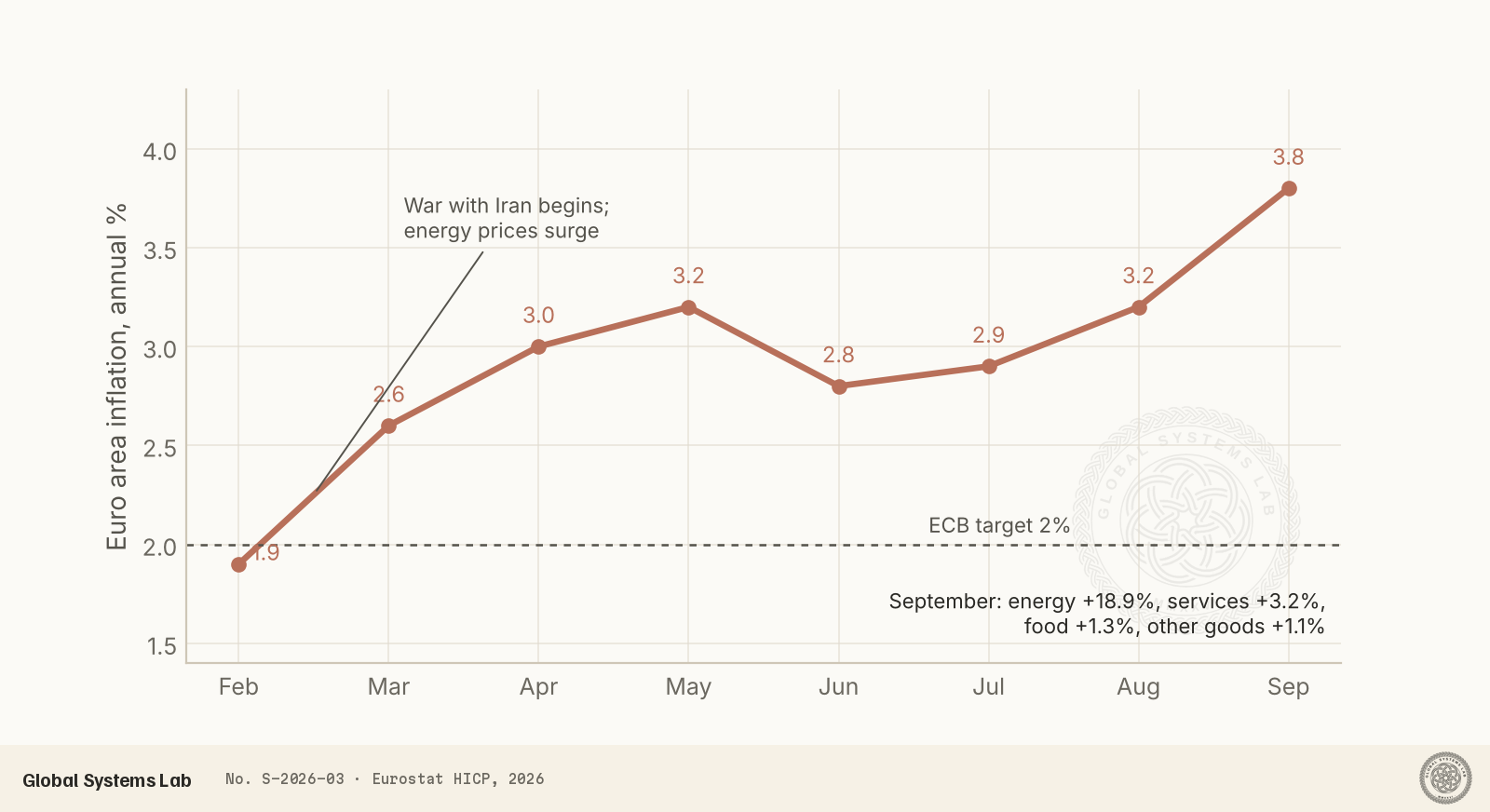
This special report reviews the state of the European economy in autumn 2026, using official data from Eurostat, the European Central Bank (ECB), the International Monetary Fund (IMF) and the European Commission, together with market data on energy prices. Since the war between the United States and Iran began in February, disruption to shipping through the Strait of Hormuz has more than tripled European wholesale gas prices and pushed oil above $110 a barrel. Activity has so far held up better than forecasters expected. Euro area GDP grew 0.4% in the third quarter, and 1.3% on a year earlier, supported by German public spending, strong growth in Spain and investment in artificial intelligence. Prices have not held up so well. Inflation rose from 1.9% in February to 3.8% in September, its highest in three years, driven by energy prices up nearly 19% on the year. The ECB raised interest rates in June and September and held them in October, and markets expect a further rise in December. Official forecasts see growth of about 1% this year and inflation above 3%, falling back towards 2% by 2028, provided energy prices ease. The main risk is a hard winter: gas storage entered the heating season at its lowest level for the time of year since records began.
Key findings
- Euro area GDP grew 0.4% in Q3 2026 and 1.3% year on year, above market expectations of 0.2%, according to Eurostat’s preliminary flash estimate. Spain and the Netherlands grew 0.6%, Germany 0.2%; Italy stagnated and France contracted by 0.1%.
- Inflation reached 3.8% in September, up from 1.9% in February before the war. Energy prices were up 18.9% on the year and contributed 1.7 percentage points; core inflation was 2.5%.
- The ECB has raised its deposit rate twice, to 2.50%, and held in October. Its staff expect inflation of 3.0% in 2026, 2.5% in 2027 and 2.1% in 2028.
- European gas prices rose above €100 per MWh in late October for the first time since 2022, from about €30 before the war. EU gas storage was about 75% full, against 83% a year earlier.
- Unemployment has edged up to 6.5% from 6.3% a year earlier. Official forecasts put 2026 growth at 0.9–1.1% and 2027 at 1.2–1.4%.
Introduction
At the start of 2026 the European economy looked set for a quiet recovery. Inflation was just under the European Central Bank’s 2% target, interest rates had been cut to 2%, and Germany was beginning to spend its new defence and infrastructure funds. Then, in February, war broke out between the United States and Iran. Shipping through the Strait of Hormuz, the route for much of the world’s oil and liquefied natural gas (LNG), has been disrupted ever since, and Europe, which imports most of its energy, has been hit harder than most.
Nine months on, this special report asks how the European economy has coped. Is it still growing? How far has inflation risen, and how is the ECB responding? And what do the official forecasters expect for the winter and beyond? It draws only on official statistics and published forecasts from Eurostat, the ECB, the IMF and the European Commission, with energy prices from market reports. It focuses on the euro area, the 21 countries that share the euro since Bulgaria joined in January, and refers to the wider EU where the data allow.
Growth: slower, but still positive
The economy has proved more resilient than forecasters expected. In the third quarter of 2026, seasonally adjusted GDP grew by 0.4% in the euro area and 0.5% in the EU compared with the previous quarter, according to Eurostat’s preliminary flash estimate of 30 October. That is down from 0.6% and 0.7% in the second quarter, but well ahead of the 0.2% that markets expected. Compared with a year earlier, euro area output was 1.3% higher, slightly faster than in the second quarter.
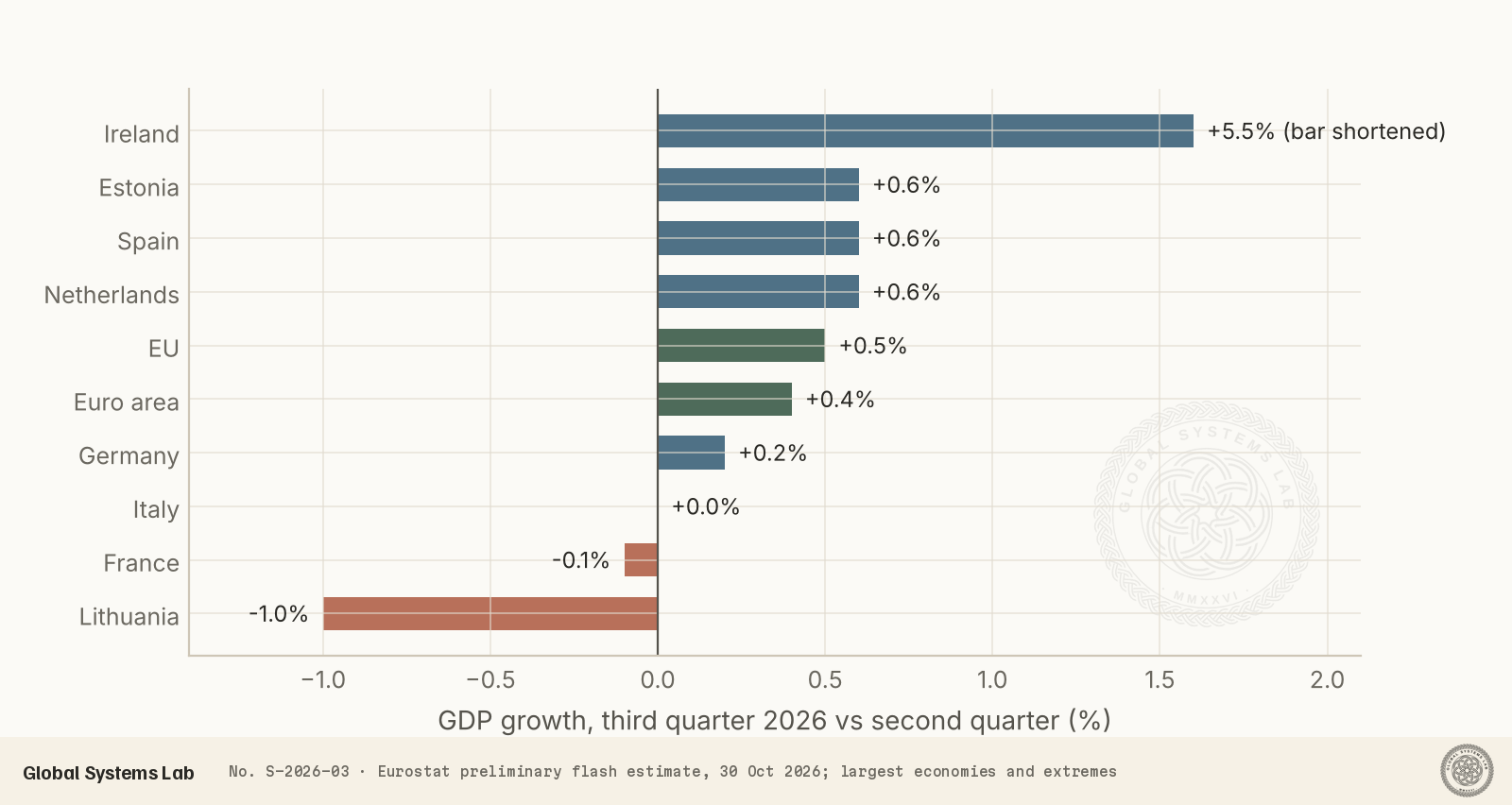
The aggregate hides wide differences. Ireland’s GDP jumped 5.5%, a figure Eurostat labels experimental and that, as usual, mostly reflects the accounts of large multinationals rather than activity on the ground. Spain, Estonia and the Netherlands grew 0.6%, continuing a strong run for the Spanish economy. Germany grew 0.2%, its fourth consecutive quarter of growth, with economists pointing to public spending on infrastructure and defence as the main support while private demand stays subdued. Italy stalled, and France contracted slightly, by 0.1%. Lithuania fell 1.0%.
Two forces are holding growth up. The first is fiscal policy in Germany, where reform of the debt brake has freed defence spending above 1% of GDP and a €500 billion infrastructure fund is starting to flow. The second is investment, including investment linked to artificial intelligence, which the ECB and IMF both cite as a source of resilience, alongside a labour market that is still close to full employment.
Business surveys suggest momentum is fading. The HCOB flash composite purchasing managers’ index (PMI) fell to 51.9 in October from 53.1 in September. That still signals growth, since any reading above 50 means expansion, but at a slower pace, and it fell short of the 52.7 that economists expected.
Inflation: back above target
Inflation is where the energy shock shows most clearly. Euro area inflation was 1.9% in February 2026, just below the ECB’s target. It jumped to 2.6% in March as energy prices rose, reached 3.2% in May, eased a little over the summer, then climbed again to 3.2% in August and 3.8% in September, the highest in three years. EU-wide inflation was also 3.8%.
The cause is plain in the breakdown. In September energy prices were 18.9% higher than a year earlier and alone added 1.7 percentage points to inflation. Services inflation was 3.2%, food, alcohol and tobacco 1.3%, and other goods 1.1%. Core inflation, which excludes energy, food, alcohol and tobacco, was 2.5%, above target but relatively stable. That is the distinction the ECB is watching: so far, the energy shock has raised prices directly, without yet setting off a spiral of wages and prices.
The burden is uneven. Among the large economies, September inflation was 5.0% in Spain, 4.2% in Italy, 3.4% in France, 3.3% in Germany and 3.0% in the Netherlands. Across the EU it ranged from 6.5% in Romania to 1.0% in Sweden.
Energy: gas prices back to crisis levels
Europe went into the war well supplied, but energy prices have risen steadily since. The Dutch TTF benchmark for wholesale gas traded at around €30 per megawatt-hour in February. It passed €70 at the end of August as storage refilling fell behind, and in late October, as the conflict spread to attacks on Saudi energy facilities and Qatari LNG exports remained curtailed, it rose above €100 for the first time since the 2022 crisis, more than three times its pre-war level. Brent crude oil has traded above $110 a barrel.
The most important number for this winter is gas in storage. EU storage sites were about 75% full in late October, compared with about 83% a year earlier, the lowest level for the time of year since records began. High prices slowed the refilling of storage over the summer, and some countries, including Germany and the Netherlands, were at risk of missing their national targets. Analysts expect European gas prices to stay high well into 2027 even if the conflict eases, because storage will have to be rebuilt.
The ECB: back to raising rates
The ECB cut its deposit rate to 2.00% in 2025. Faced with the energy shock, it reversed course this summer, raising rates by 0.25 percentage points in June and again on 10 September, taking the deposit rate to 2.50%. At the September meeting it said inflation was set to stay well above target for an extended period.
On 29 October it held rates, with the deposit facility, main refinancing and marginal lending rates at 2.50%, 2.65% and 2.90%. Its statement said rising energy prices posed upside risks to inflation and downside risks to growth, and that the larger and longer energy shock was likely to drive inflation up and growth down. It noted that underlying inflation had stayed broadly stable and that wages had not yet responded materially. Christine Lagarde said the Governing Council had discussed a rise but agreed unanimously to wait. Several banks expect a further rise at the next meeting on 17 December. Lagarde has also said she will step down as ECB president in February 2027, before the end of her term.
Jobs and households
The labour market is still strong, but it has started to soften. Euro area unemployment was 6.5% in September, unchanged from August but up from 6.2% in May and 6.3% a year earlier. Some 11.6 million people in the euro area were unemployed, 420,000 more than a year before. Youth unemployment was 15.4%.
For households, the shock arrives through energy bills and borrowing costs. Real incomes are being squeezed as prices outpace wage growth, which slowed to 3.3% in the second quarter on the ECB’s measure. Variable-rate mortgages tied to Euribor, common in Spain and Portugal, have become more expensive as markets anticipate further ECB rises. The IMF points to weak consumer confidence as a main brake on growth.
What the forecasters expect
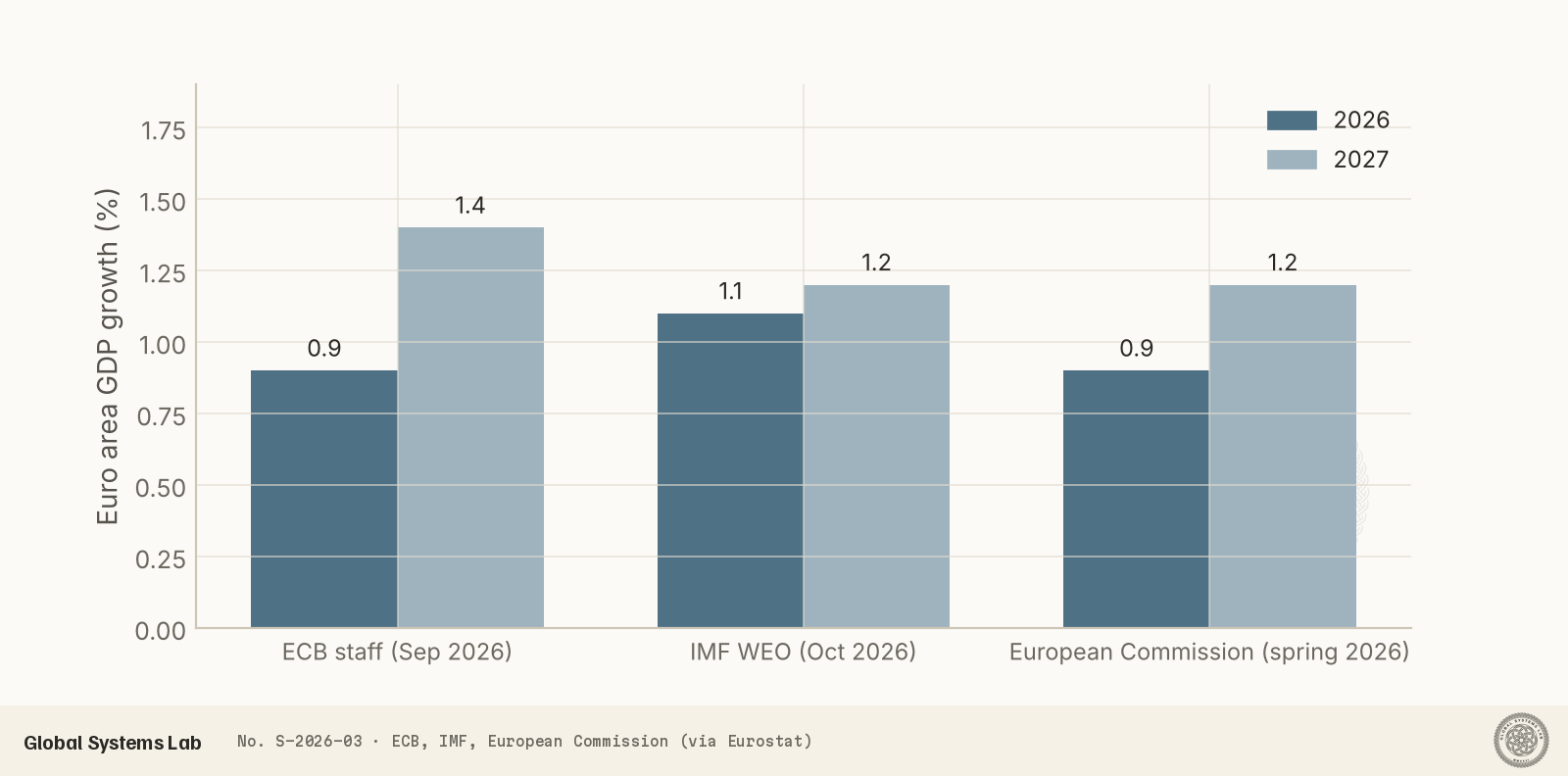
The official forecasts are close together. ECB staff projected in September that the euro area would grow 0.9% in 2026, 1.4% in 2027 and 1.5% in 2028, an upward revision for 2026 and 2027 because the economy had proved more resilient than expected. The IMF’s October World Economic Outlook forecast 1.1% for 2026, up from 0.9% in July, and 1.2% for 2027. The European Commission’s spring forecast, which predates the worst of the summer’s energy rise, put 2026 at 0.9% and 2027 at 1.2%. The Commission publishes its autumn forecast in mid-November.
On inflation the ECB staff expect 3.0% in 2026, falling to 2.5% in 2027 and 2.1% in 2028, a path in which inflation peaks in late 2026 and then eases as energy prices fall. The IMF is more cautious, at 3.1% this year and 2.8% next. Both forecasts depend on the energy path. In the ECB’s more severe scenario, inflation stays at 3.2% in 2027 and growth weakens markedly. In its milder scenario, inflation falls below target.
Risks
The risks lean towards higher inflation and weaker growth.
- A cold winter with low storage. With gas storage at a record low for the season, a cold winter or a further loss of LNG supply could push prices well above current levels, forcing demand cuts in industry.
- Escalation in the Gulf. Attacks on Saudi energy facilities in October showed how quickly the conflict can spread. A wider disruption would hit oil and gas together.
- Second-round effects. If high inflation begins to feed through into wage settlements, the ECB may have to raise rates further, at a cost to growth.
- Fiscal strains. Government borrowing costs have risen. Countries with high debt and little growth, including France and Italy, are the most exposed.
- Upside risks. A ceasefire that reopened Hormuz shipping would likely bring energy prices down quickly. The ECB’s milder scenario shows inflation could then fall below target by 2027.
Conclusions
Europe’s economy has absorbed a large energy shock better than expected. It is still growing, unemployment is still low, and the German fiscal expansion is starting to work. The cost has come in inflation, which has doubled since February, and in a return to higher interest rates. The coming winter is the real test. With gas storage at a record low and prices above €100, Europe’s growth and inflation over the next six months depend less on its own policies than on the weather and on events in the Gulf. The forecasts agree that inflation should fall back towards 2% by 2028. Whether it does will depend on energy prices falling as expected. The next data points to watch are October inflation on 4 November, the second estimate of third-quarter GDP and the Commission’s autumn forecast in mid-November, and the ECB’s decision on 17 December.
References
- Eurostat (2026). GDP up by 0.4% in the euro area and by 0.5% in the EU. Preliminary flash estimate for the third quarter of 2026, 30 October 2026. https://ec.europa.eu/eurostat/web/products-euro-indicators/w/2-30102026-ap
- Eurostat (2026). Annual inflation up to 3.8% in the euro area, 16 October 2026; Annual inflation up to 2.9% in the euro area, 19 August 2026. https://ec.europa.eu/eurostat/web/products-euro-indicators/w/2-16102026-ap
- Eurostat (2026). Euro area unemployment, September 2026, 30 October 2026; July 2026, 1 September 2026. https://ec.europa.eu/eurostat/en/web/products-euro-indicators/w/3-01092026-bp
- European Central Bank (2026). Monetary policy decisions, 10 September and 29 October 2026. https://www.ecb.europa.eu/press/pr/date/2026/html/ecb.mp261029~9a493adf17.en.html
- European Central Bank (2026). ECB staff macroeconomic projections for the euro area, September 2026. https://www.ecb.europa.eu/press/projections/html/ecb.projections202609_ecbstaff~8e340fc69d.en.html
- European Central Bank (2026). Account of the monetary policy meeting of 9–10 September 2026. https://www.ecb.europa.eu/press/accounts/2026/html/ecb.mg261008~a10153d090.en.html
- International Monetary Fund (2026). World Economic Outlook: Resilience under Strain, Urgent Choices. October 2026. https://www.imf.org/en/Publications/WEO/Issues/2026/10/13/world-economic-outlook-october-2026
- Eurostat (2026). Eurostatistics: data for short-term economic analysis (overview of European Commission, ECB, IMF and OECD forecasts). https://ec.europa.eu/eurostat/statistics-explained/index.php?title=Eurostatistics_-_data_for_short-term_economic_analysis
- Euronews (2026). European gas prices spike above €70 amid renewed Middle East fighting, 31 August 2026. https://www.euronews.com/2026/08/31/european-gas-prices-spike-above-70-amid-renewed-middle-east-fighting
- Oilprice.com (2026). European gas tops 101 euros for first time since 2022, 30 October 2026. https://oilprice.com/Latest-Energy-News/World-News/European-Gas-Tops-101-Euros-for-First-Time-Since-2022.html
- Seoul Economic Daily (2026). European gas prices hit 4-year high, triple since Iran war, 29 October 2026. https://en.sedaily.com/international/2026/10/29/european-gas-prices-hit-4-year-high-triple-since-iran-war
- House of Commons Library (2026). Interest rates and monetary policy: economic indicators. https://commonslibrary.parliament.uk/research-briefings/sn02802/
Data availability
The official figures behind the charts are available below as a single CSV file: third-quarter GDP growth by economy, monthly euro area inflation and unemployment, and the latest official forecasts. All figures were transcribed from the releases listed in the references on 2 November 2026. Flash estimates are revised: Eurostat’s next estimate of third-quarter GDP is due on 13 November, and the October inflation flash estimate on 4 November.
Cite this
Global Systems Lab (2026). Europe's economy in an energy shock: growth holds, inflation returns. Global Systems Lab Transmission S-2026-03. https://globalsystemslab.com/transmission/european-economy-autumn-2026
BibTeX
@techreport{lab2026european,
  author = {Global Systems Lab},
  title = {Europe's economy in an energy shock: growth holds, inflation returns},
  institution = {Global Systems Lab},
  number = {S-2026-03},
  year = {2026},
  month = {nov},
  url = {https://globalsystemslab.com/transmission/european-economy-autumn-2026}
}