Abstract
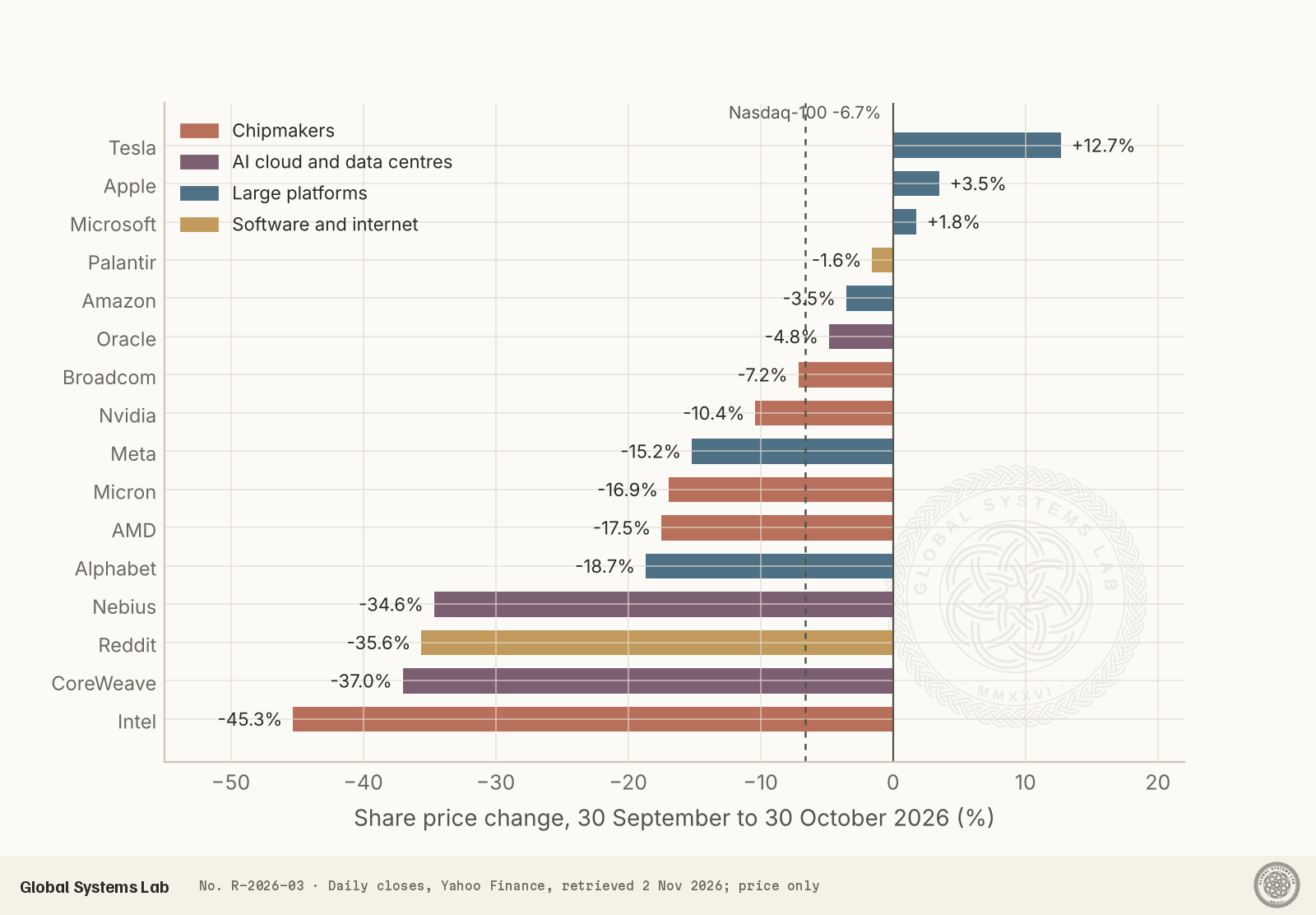
US technology stocks fell sharply in October 2026. The Nasdaq Composite lost 5.3% over the month and the Nasdaq-100 briefly fell 10% below its 6 October record on 30 October, a technical correction, before recovering slightly into the close. More than $2 trillion was wiped from the Nasdaq-100’s value. We analysed daily closing prices for 16 large technology stocks, alongside company results and market reporting, to understand what happened. The sell-off was not indiscriminate. The broader S&P 500 fell only 0.9% and health care stocks rose almost 10%. Among technology companies, the losers shared three features: heavy and rising spending on AI infrastructure with weak or negative free cash flow, a business exposed to that spending as a supplier or a debt-financed builder, or a business that AI itself is disrupting. Companies whose AI revenue was visibly growing, notably Microsoft, held up. Intel (−45%), CoreWeave (−37%), Reddit (−36%) and Nebius (−35%) suffered most; Alphabet lost 19% and more than $500 billion in value, much of it in a single day. The pattern suggests a market demanding evidence that AI spending will pay off, rather than one abandoning the AI investment cycle.
Key findings
- The Nasdaq Composite fell 5.3% in October and the Nasdaq-100 6.7%, while the S&P 500 lost only 0.9% and health care stocks gained 9.8%: a rotation out of technology, not a general market collapse.
- Intel fell 45% in the month, including 28.6% on 30 October, its worst day since 1974, after a weak fourth-quarter forecast tied to a shrinking PC market and a factory accident.
- AI cloud builders fell hardest as a group: CoreWeave −37% and Nebius −35%. Chipmakers AMD (−18%), Micron (−17%) and Nvidia (−10%) followed their customers’ spending signals down.
- Alphabet lost 12.6% on 29 October after missing estimates and reporting negative free cash flow of $9.1 billion; Meta fell 15% in the month after lifting its 2026 capital spending range to $135–145 billion.
- Microsoft (+1.8%), Apple (+3.5%) and Tesla (+12.7%) rose. Microsoft’s Azure cloud grew 48%, above guidance: the clearest evidence of AI revenue was rewarded.
Introduction
For most of 2026, artificial intelligence has carried the US stock market. The S&P 500 set 28 record closes this year, the last on 6 October, and the Nasdaq-100 peaked the same day. Then, over three weeks, the mood turned. A series of quarterly results from the largest technology companies, combined with ever-larger plans for AI spending, led investors to ask whether that spending would earn a return. By the end of October more than $2 trillion had been erased from the Nasdaq-100.
This report looks at what happened, company by company. Which stocks fell, and by how much? Which held up? And what do the winners and losers have in common? We focus on 16 of the largest and most closely watched US technology stocks, grouped by the kind of business they run.
This report describes past market movements for research purposes. It is not investment advice.
Data and approach
We used daily closing prices from Yahoo Finance for 16 technology stocks, two benchmark indexes and a health care sector fund, from 28 September to 2 November 2026. We grouped the companies into four types:
- Large platforms: Microsoft, Apple, Alphabet, Amazon, Meta and Tesla.
- Chipmakers: Nvidia, Broadcom, AMD, Intel and Micron.
- AI cloud and data centres: Oracle and the “neocloud” operators CoreWeave and Nebius, which rent out AI computing capacity.
- Software and internet: Palantir and Reddit.
For each we measured the price change over October (30 September to 30 October close), the fall from its October high, and its largest one-day loss. We matched the biggest moves to the company results and announcements reported at the time.
How the month unfolded
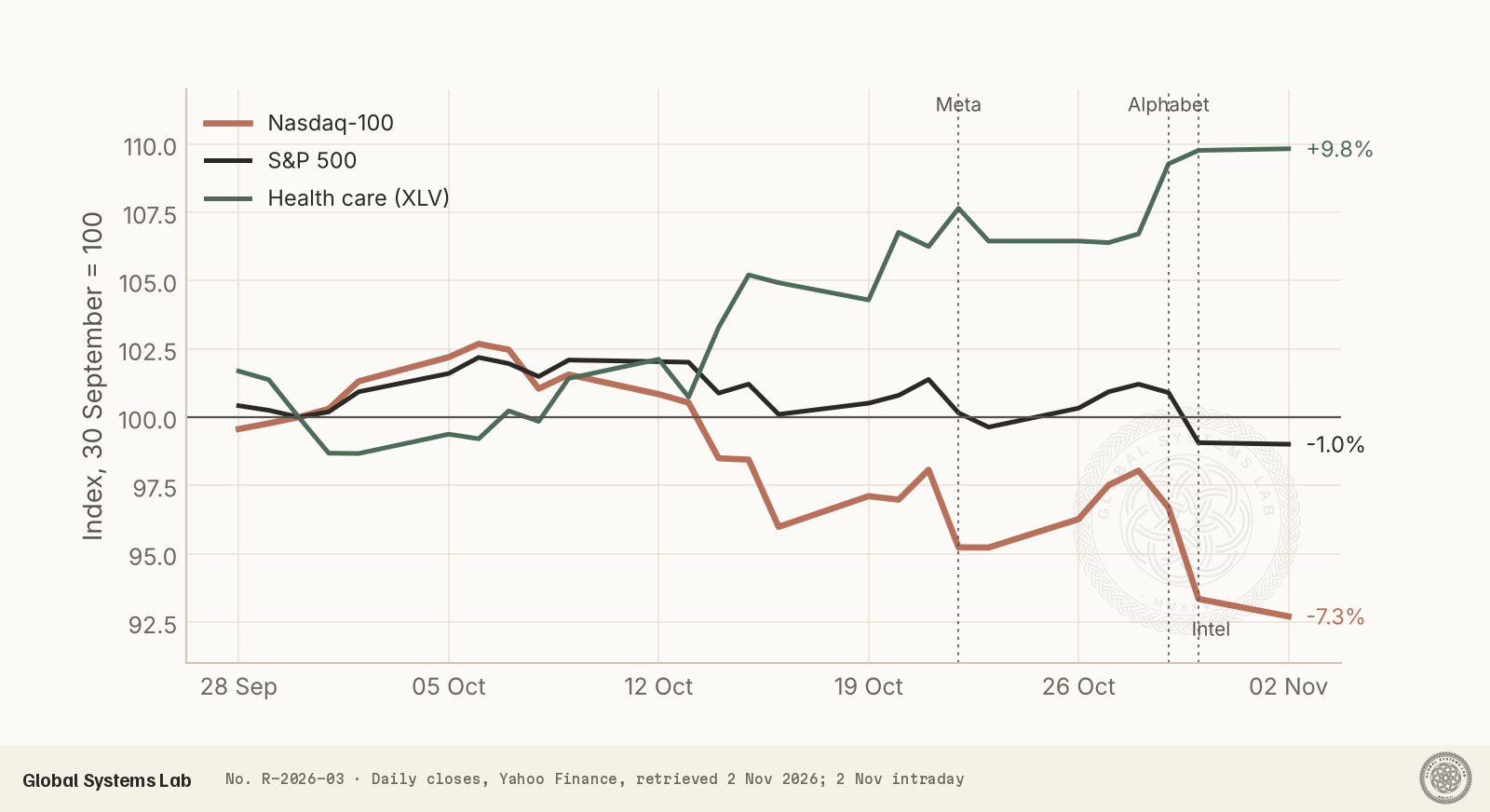
The month began well. The Nasdaq-100 rose 2.7% to a record 31,224 on 6 October. From there it slid in three steps.
- Mid-October: the AI infrastructure trade wobbles. Between 8 and 16 October the most leveraged parts of the AI build-out fell first. CoreWeave dropped 15.5% on 14 October and Nebius 12% on 16 October. Memory maker Micron and AMD fell steadily.
- 22 October: Meta. Meta raised the low end of its 2026 capital spending range to $135–145 billion and reports of a record $97.5 billion fundraising raised fears about debt and dilution. Its shares fell 7% and the Nasdaq Composite lost 2.6%.
- 29–30 October: the earnings crescendo. Alphabet fell 12.6% on 29 October after its results. The next day Amazon’s results and Intel’s forecast hit together. The Nasdaq Composite fell 2.9% and the S&P 500 1.8%, both their worst days since June. The Nasdaq-100 briefly traded 10% below its record, the threshold for a correction, before closing 9.1% below it.
For October as a whole the Nasdaq Composite fell 5.3%, its worst month since March 2025, and the Nasdaq-100 6.7%. The Nasdaq and the S&P 500 both fell for a third straight week. Yet the S&P 500 lost less than 1%, the Dow Jones Industrial Average rose 1.7%, and health care stocks gained almost 10%. Money did not leave the stock market. It moved out of technology and into defensive sectors.
The losers, and why
Intel: the month’s worst performer
Intel fell 45% in October, making it the worst-performing stock in the S&P 500. Most of the damage came on 30 October, when it dropped 28.6%. Only one day since the 1970s was worse, a 29.9% fall in July 1974. The irony is that Intel’s quarter was good: revenue rose 21% to $16.5 billion and adjusted earnings beat estimates. The problem was the outlook. Intel forecast fourth-quarter revenue of $15–16 billion, against about $17 billion expected, and warned of a steep fall in PC chip sales as a shortage of memory chips drives up PC prices and depresses demand. An October accident at its factory in Kiryat Gat, Israel, which killed two people, is expected to cut fourth-quarter revenue by about $300 million. Intel’s fall was also a reversal of an extraordinary rally: its shares had risen 278% in the first half of 2026.
The neoclouds: spending on credit
CoreWeave (−37%) and Nebius (−35%) were the hardest-hit group. Both build data centres and rent AI computing power, and both fund much of that expansion with debt. They are the most direct bet on AI demand continuing to outrun supply, and they are the most exposed to rising borrowing costs. With the 10-year Treasury yield near 4.9% and the Federal Reserve expected to raise rates again in December, the cost of that debt is rising. Oracle, which is building data centres on a large scale, fell 4.8% over the month but almost 10% from its October high.
Alphabet and Meta: the cost of the arms race
Alphabet lost 18.7% in October and more than $500 billion in market value on 29 October alone, when its shares fell 12.6%. The company missed analysts’ estimates for earnings and revenue and reported negative free cash flow of about $9.1 billion, as quarterly capital spending reached about $51 billion. For a company long prized for its cash generation, spending more cash than it brought in was a shock.
Meta fell 15.2%. Its results did not disappoint so much as its plans: capital spending of up to $145 billion in 2026, alongside plans for a record $97.5 billion fundraising. Investors are no longer willing to accept rising AI budgets on trust.
The chip suppliers: when customers’ plans wobble
Chipmakers sell the equipment the AI build-out runs on, so their shares move with their customers’ spending plans. Nvidia fell 10.4%, AMD 17.5%, Micron 16.9% and Broadcom 7.1%. None reported bad news of its own in October. The concern is about the rate of change: even if the giant platforms keep spending heavily, slower growth in that spending would mean slower growth for suppliers. As Nvidia slipped, Apple briefly overtook it as the world’s most valuable company, at around $5 trillion.
Reddit: disrupted by AI, not spending on it
Reddit fell 35.6%, including 29.2% on 30 October, its worst day since it listed in 2024. Its results beat expectations, but it forecast fourth-quarter revenue of $1.0–1.03 billion, below estimates, and warned that daily users could fall by a low double-digit percentage. Its chief executive said visits referred by search engines had fallen by more than a million a week in October. Reddit’s problem is the opposite of Meta’s: it is a business whose traffic is being eroded as people get answers from AI assistants instead of clicking through to websites.
The companies that held
Not every technology stock fell. Microsoft rose 1.8% in October. Its quarterly results showed revenue up 19% to $92.3 billion and its Azure cloud business growing 48%, above its own forecast of 44–45%. Microsoft is spending heavily too, but it could point to AI revenue growing fast enough to justify the cost. Apple rose 3.5%; it spends far less on AI infrastructure than its peers. Tesla gained 12.7%. Amazon fell only 3.5% over the month despite missing estimates and reporting negative free cash flow of about $42 billion, and its shares bounced 3.4% on 2 November.
What the pattern shows
Set side by side, the moves follow a clear logic. The market did not punish AI as such. It punished three things:
- Spending without visible returns. Alphabet and Meta, whose AI budgets rose faster than their AI revenue, fell; Microsoft, which showed AI-driven growth above guidance, did not.
- Leverage to the build-out. The companies whose fortunes depend most on continued growth in AI spending, the neoclouds and chip suppliers, fell further than the companies doing the spending.
- Disruption by AI. Businesses that AI threatens, like Reddit’s search-driven traffic, were repriced sharply.
Intel stands somewhat apart: its collapse owed more to the PC market and its own operations than to AI spending, though the memory shortage hurting PCs is itself a side effect of the AI boom.
The scale of the spending explains the nervousness. By JPMorgan’s estimates, capital spending by the five largest cloud companies passed $400 billion in 2025 and is approaching $900 billion in 2026. Such sums must eventually be repaid from revenue. October was the month investors began insisting on seeing it.
Uncertainty and limitations
This analysis covers a single month and 16 stocks, chosen for their size and prominence; it is not a complete picture of the technology sector. Price changes exclude dividends. Our grouping of companies is a simplification: Amazon, for example, is both a platform and a cloud builder. Explanations for share price moves are drawn from company results and contemporary reporting, and markets often move for reasons that are only clear later. Prices for 2 November are intraday. Nothing in this report is a forecast of future prices or a recommendation to buy or sell any security.
Conclusions
October 2026 was a sharp, selective sell-off in US technology stocks, not a crash of the whole market. It erased more than $2 trillion from the Nasdaq-100 and pushed the index briefly into a correction, but the S&P 500 ended the month almost flat. The losses landed where AI spending was largest relative to its visible returns, where companies were most exposed to that spending as suppliers or borrowers, and where AI was eating into existing businesses. The coming weeks will test whether this is a pause or a turning point: Apple reports on 2 November, Nvidia in mid-November, and the Federal Reserve’s December decision will set the cost of money for the borrowers funding the build-out.
References
- Yahoo Finance. Daily price history for the Nasdaq-100, S&P 500, Health Care Select Sector SPDR (XLV) and 16 US technology stocks, 28 September to 2 November 2026. Retrieved 2 November 2026. https://finance.yahoo.com/
- Reuters (2026). Nasdaq faces $2 trillion wipeout in October as AI spending fears deepen, 30 October 2026 (via MarketScreener). https://www.marketscreener.com/news/nasdaq-faces-2-trillion-wipeout-in-october-as-ai-spending-fears-deepen-ce785fdbdf8df122
- Bloomberg (2026). Stocks slump as Wall Street gets AI wake-up call: Markets Wrap, 30 October 2026. https://www.bloomberg.com/news/articles/2026-10-29/stock-market-today-dow-s-p-live-updates
- Wealth Professional (2026). Nasdaq tech sell-off caps worst October since March 2025, 2 November 2026. https://www.wealthprofessional.ca/investments/equity-markets/nasdaq-tech-sell-off-october-2026/393915
- Yahoo Finance (2026). The Nasdaq 100 briefly fell into a correction as the AI trade cracks, 31 October 2026. https://finance.yahoo.com/markets/stocks/articles/nasdaq-100-briefly-fell-correction-145406645.html
- NBC News (2026). Tech stocks wipe out $1 trillion in value as concerns deepen about the AI boom, 30 October 2026. https://www.nbcnews.com/business/markets/tech-stocks-nasdaq-ai-boom-fears-deepen-rcna606512
- IBTimes Australia (2026). Intel stock crashes 27% in worst day in decades as memory shortage wrecks PC outlook and Q4 forecast misses. https://www.ibtimes.com.au/intel-shares-plunge-weak-pc-outlook-forecast-1877636
- ROIC.ai (2026). Intel shares plunge 29%, set for sharpest one-day percentage drop on record, 30 October 2026. https://www.roic.ai/news/intel-shares-plunge-29-set-for-sharpest-one-day-percentage-drop-on-record-10-30-2026
- Digital Today (2026). Reddit shares plunge 30 percent on weak fourth-quarter forecast. https://www.digitaltoday.co.kr/en/view/122117/reddit-shares-plunge-30-percent-on-weak-fourth-quarter-forecast
- Constellation Research (2026). Microsoft delivers strong quarter, Azure growth up 48%, 28 October 2026. https://www.constellationr.com/insights/news/microsoft-delivers-strong-q3-azure-growth-48
- Intellectia (2026). AI spending fears trigger $1 trillion tech selloff (Meta capital expenditure guidance). https://intellectia.ai/blog/ai-spending-fears-tech-selloff-october-2026
- The Motley Fool (2026). The Nasdaq just flashed a signal investors can’t afford to ignore, 1 November 2026 (JPMorgan hyperscaler capex estimates). https://www.fool.com/investing/2026/11/01/nasdaq-flash-signal-history-says-stock-market-do-this-next/
Data availability
Two data files are available below: daily closing prices for all 19 securities from 28 September to 2 November 2026, and a summary table with each stock’s October change, its fall from its October high, its worst single day and its move on 2 November. Prices were retrieved from Yahoo Finance on 2 November 2026; the 2 November values are intraday. Returns are price changes and exclude dividends.
Cite this
Global Systems Lab (2026). The October 2026 tech sell-off: who fell, who held, and why. Global Systems Lab Transmission R-2026-03. https://globalsystemslab.com/transmission/tech-selloff-october-2026
BibTeX
@techreport{lab2026tech,
  author = {Global Systems Lab},
  title = {The October 2026 tech sell-off: who fell, who held, and why},
  institution = {Global Systems Lab},
  number = {R-2026-03},
  year = {2026},
  month = {nov},
  url = {https://globalsystemslab.com/transmission/tech-selloff-october-2026}
}