Abstract
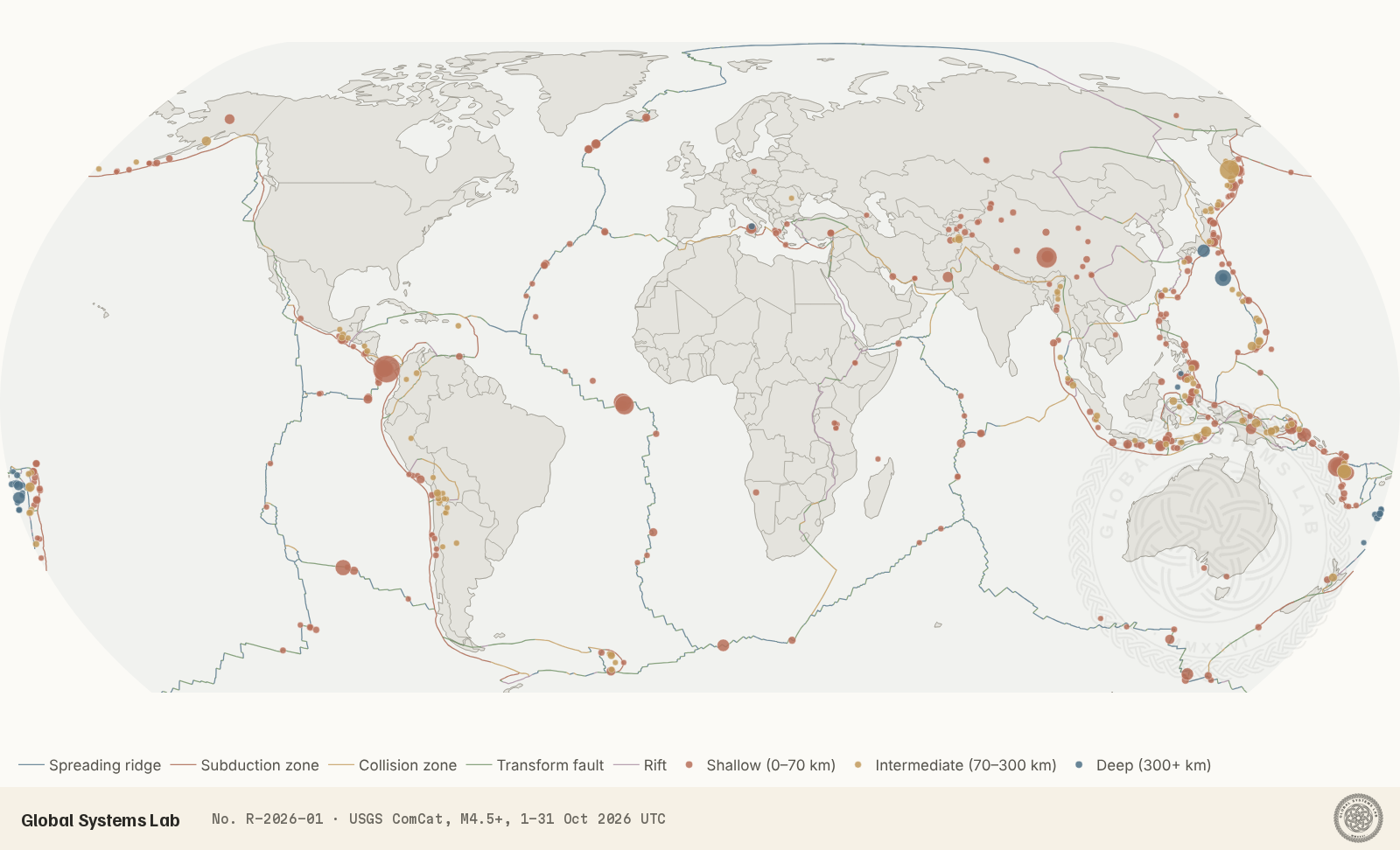
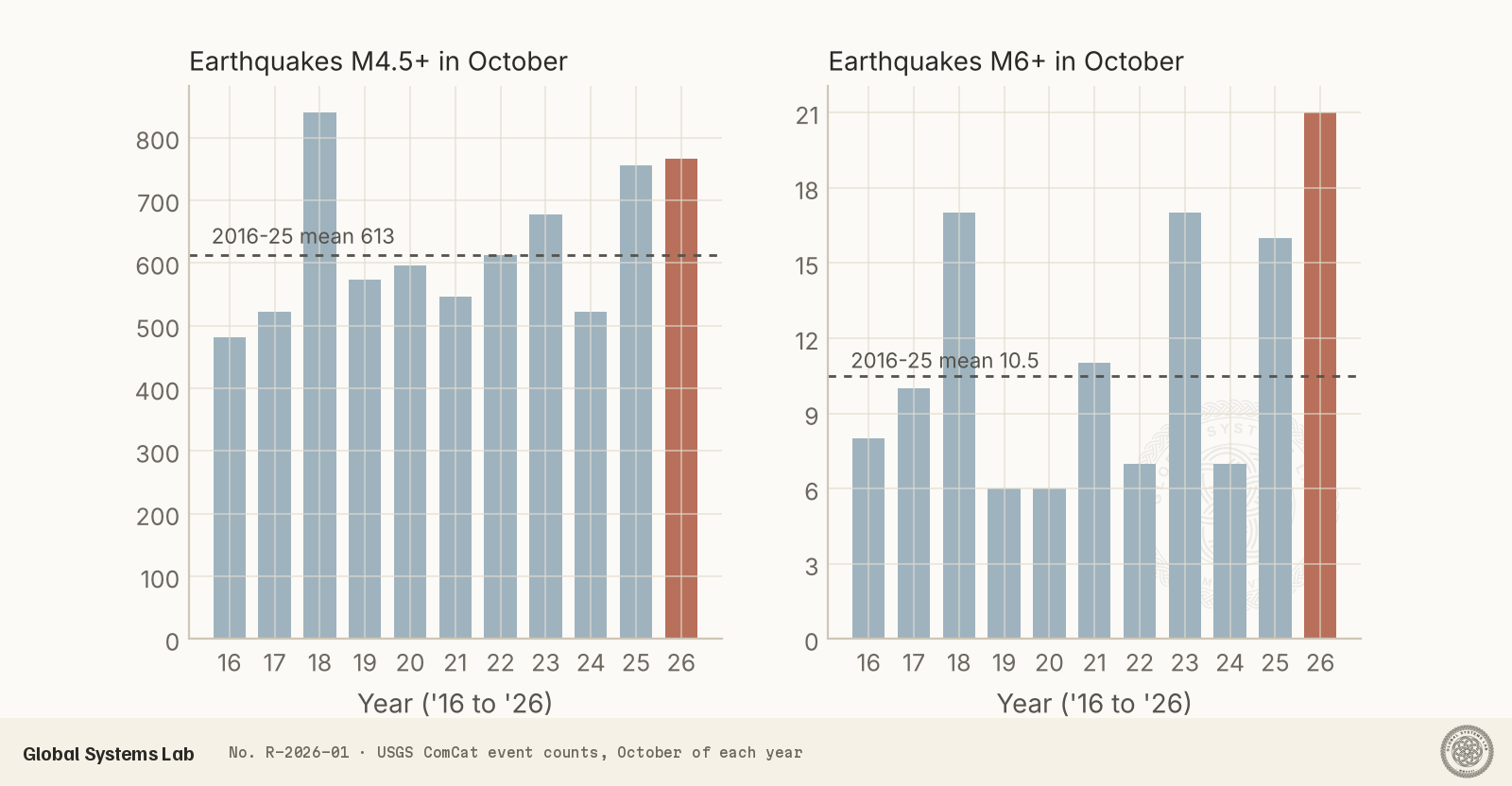
We reviewed every earthquake of magnitude 4.5 or larger that the US Geological Survey catalogued worldwide between 1 and 31 October 2026 (UTC), using the lab’s Earthquake Explorer. The month held 766 such earthquakes, 25% more than the October average for 2016–2025 (613), and 21 of magnitude 6 or larger, twice the ten-year October average of 10.5 and the most in any October of that period. Two sequences drove most of the excess: a magnitude 7.7 earthquake off western Panama on 9 October, followed by 103 aftershocks of magnitude 4.5 or larger, and a long, swarm-like sequence north-west of Vanuatu that produced 116 earthquakes and eight of magnitude 6 or more. A magnitude 7.0 earthquake struck the Tibetan Plateau on 22 October. Busy months like this one fall within the normal range of year-to-year variation; they do not, on their own, signal a change in global earthquake activity.
Key findings
- 766 earthquakes of magnitude 4.5 or larger struck in October 2026, 25% above the 2016–2025 October average of 613. Only October 2018 (840) had more.
- 21 earthquakes reached magnitude 6 or more, double the ten-year October average (10.5) and the highest October count in eleven years. Two exceeded magnitude 7.
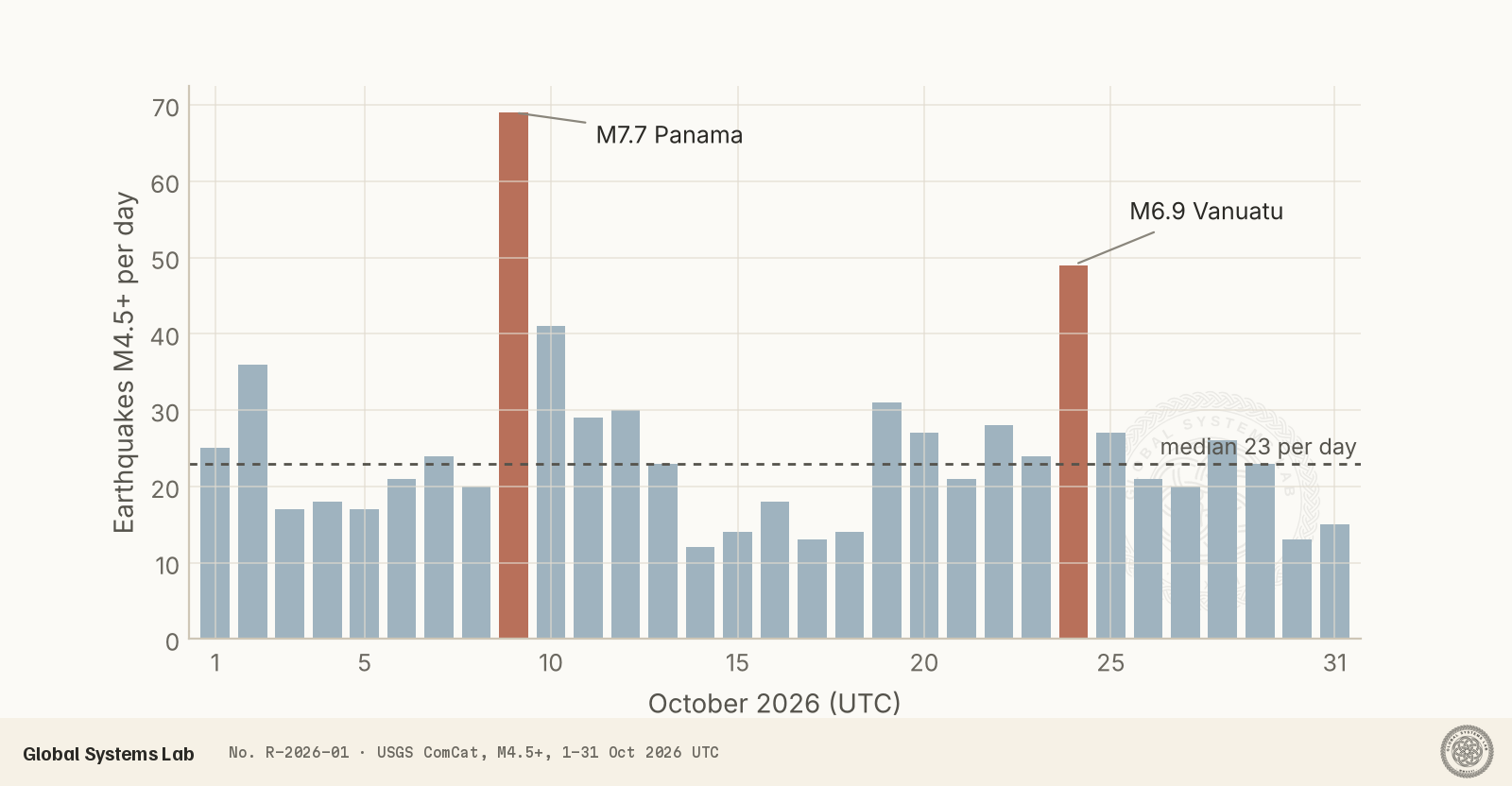
- The magnitude 7.7 Panama earthquake of 9 October released about two-thirds of all the month’s seismic energy and set off 103 aftershocks of magnitude 4.5 or more, 73 of them within a day.
- North-west of Vanuatu, 116 earthquakes in one month, including eight of magnitude 6 or more and no single dominant mainshock, made it the most active place on Earth in October.
- Four in five of the month’s earthquakes were shallower than 70 km; 33 were deeper than 300 km, the deepest 643 km beneath the Fiji region.
Introduction
Around 1,500 earthquakes of magnitude 5 or larger strike the planet in an average year, and many thousands more of magnitude 4.5. Most go unnoticed: they happen under the sea, deep in the Earth, or far from towns. A few each month are large enough, shallow enough and close enough to people to matter. This monthly review steps back from the headlines and asks three questions of October 2026. How many large earthquakes were there, and was that unusual? Where did they cluster, and why there? And what does the pattern of aftershocks tell us about the weeks ahead?
The review covers every earthquake of magnitude 4.5 or larger that the US Geological Survey (USGS) catalogued worldwide from 1 to 31 October 2026, in Coordinated Universal Time. Magnitude 4.5 is the level above which the global catalogue is close to complete: almost every earthquake that size, anywhere on Earth, is detected and measured.
Data and approach
We loaded the month’s catalogue into the lab’s Earthquake Explorer, which draws on the same USGS feed, and used it to map the events, count them by day, depth and size, and follow the aftershock sequences of the largest earthquakes. To judge whether October was unusual, we compared it with the same calendar month in each of the previous ten years, 2016 to 2025, using the USGS catalogue’s own event counts. Felt reports and impact alerts come from the USGS records for each event. All figures use magnitudes as published by the USGS on 1 November; most large events use the moment magnitude, the scale seismologists prefer for big earthquakes.
Results
A busier October than usual
October 2026 held 766 earthquakes of magnitude 4.5 or larger. The October average for 2016–2025 was 613, so this month ran about 25% above normal. Among the last eleven Octobers, only 2018, with 840, was busier. The bigger difference was at the top of the scale. Twenty-one earthquakes reached magnitude 6 or more, against a ten-year October average of 10.5, and two passed magnitude 7: the magnitude 7.7 off Panama and a magnitude 7.0 on the Tibetan Plateau. In the previous ten Octobers, magnitude 7 events numbered between none and two.
Day to day, a typical October day brought about 23 earthquakes of this size. Two days stand out: 9 October, with 69, when the Panama earthquake and its first aftershocks struck, and 24 October, with 49, when the Vanuatu sequence reached its peak.
Panama: one large rupture and a fast-fading aftershock sequence
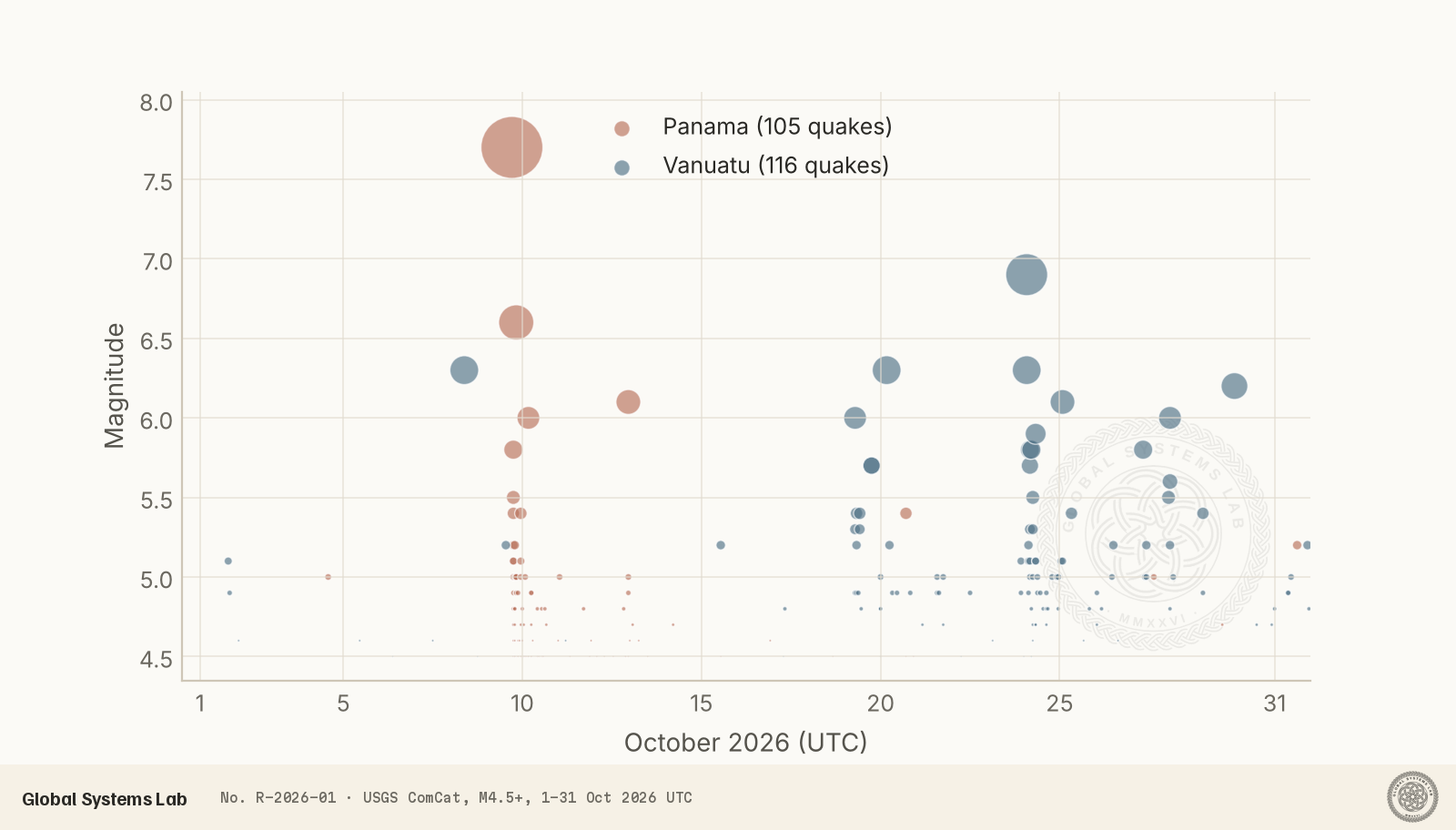
At 17:56 UTC on 9 October, a magnitude 7.7 earthquake struck about 12 km west-south-west of Pitaloza Arriba, off the Pacific coast of western Panama, at a depth of about 13 km. It was the largest earthquake of the month by a wide margin. The USGS issued an orange PAGER alert, its second-highest level, and more than 2,000 people submitted reports of shaking. On its own, this one earthquake released about two-thirds of all the seismic energy of every earthquake in the month combined, equivalent to roughly 5 of the month’s 8 megatonnes of TNT.
The region was quiet beforehand: the catalogue holds a single magnitude 5.0 event south of Panama five days earlier. The aftershocks came quickly. A magnitude 6.6 followed two and a half hours after the mainshock, then a 6.0 the next day and a 6.1 on 12 October. In all, 103 earthquakes of magnitude 4.5 or more followed by the end of the month, 27 of them magnitude 5 or larger. Seventy-three of the 103 came within the first 24 hours and 95 within the first week. That steep fall-off is the textbook pattern for aftershocks: the rate drops roughly in proportion to the time since the mainshock, so a sequence that produced dozens of events on day one produces only a handful a week later. The Earthquake Explorer’s aftershock tool fits this decay; for Panama it was, if anything, slightly faster than average.
Vanuatu: the most active place on Earth this month
North-west of Vanuatu, near the boundary where the Australian plate bends down beneath the Pacific plate, 116 earthquakes of magnitude 4.5 or larger struck during October, more than in any other region. Fifty-seven reached magnitude 5 and eight magnitude 6 or more. Most clustered about 170 to 220 km north-west of Port-Olry on Espiritu Santo, at shallow depths near 10 km.
What makes the Vanuatu sequence interesting is its shape. Instead of one mainshock followed by a decaying tail, as in Panama, it built up over days: a magnitude 6.0 on 19 October, a 6.3 the next day, then on 24 October a magnitude 6.9 followed within minutes by a 6.3, and further magnitude 6 events on 28 October. Sequences like this, with several earthquakes of similar size spread over weeks, are often called swarms. They are common along this part of the arc and can reflect a fault zone failing in several patches rather than in one rupture. Two further magnitude 6 events, at depths of 116 and 143 km near Port-Olry, belong to the sinking plate itself rather than to the shallow swarm.
The Tibetan Plateau, and the rest of the month
The second magnitude 7 of the month struck the Tibetan Plateau on 22 October, about 189 km east-north-east of Nagqu in Xizang, at a depth of about 18 km. Unlike most large earthquakes, it was far from any ocean: it was driven by the slow collision of India with Asia, which squeezes and spreads the plateau. The USGS issued an orange PAGER alert. At least 19 aftershocks of magnitude 4.5 or more followed over the next five days, the largest a magnitude 5.9 on 25 October.
Elsewhere, a magnitude 6.9 earthquake struck 135 km beneath southern Kamchatka on 16 October, while offshore an early-month cluster of shallow events continued the aftershock activity of the great magnitude 8.8 earthquake there in July 2025. Two earthquakes of magnitude 6.7 and 6.8 struck about six and a half hours apart on 13 October along the Mid-Atlantic Ridge near the equator, on the transform faults that offset the spreading ridge. A magnitude 6.5 struck 492 km beneath the Bonin Islands south of Japan, and a magnitude 6.4 on the spreading ridge south-east of Easter Island on 29 October. On land, a magnitude 5.7 near Khuzdar in Pakistan on 17 October drew a yellow PAGER alert.
Shallow, deep and everything between
Four in five of October’s earthquakes (611 of 766) were shallower than 70 km, where they are most likely to be felt. A further 122 were at intermediate depths of 70 to 300 km, and 33 were deeper than 300 km, most of them inside the Pacific plate as it sinks beneath the Tonga–Fiji arc. The deepest, 643 km beneath the Fiji region, is close to the limit below which earthquakes no longer occur.
How the sizes stack up
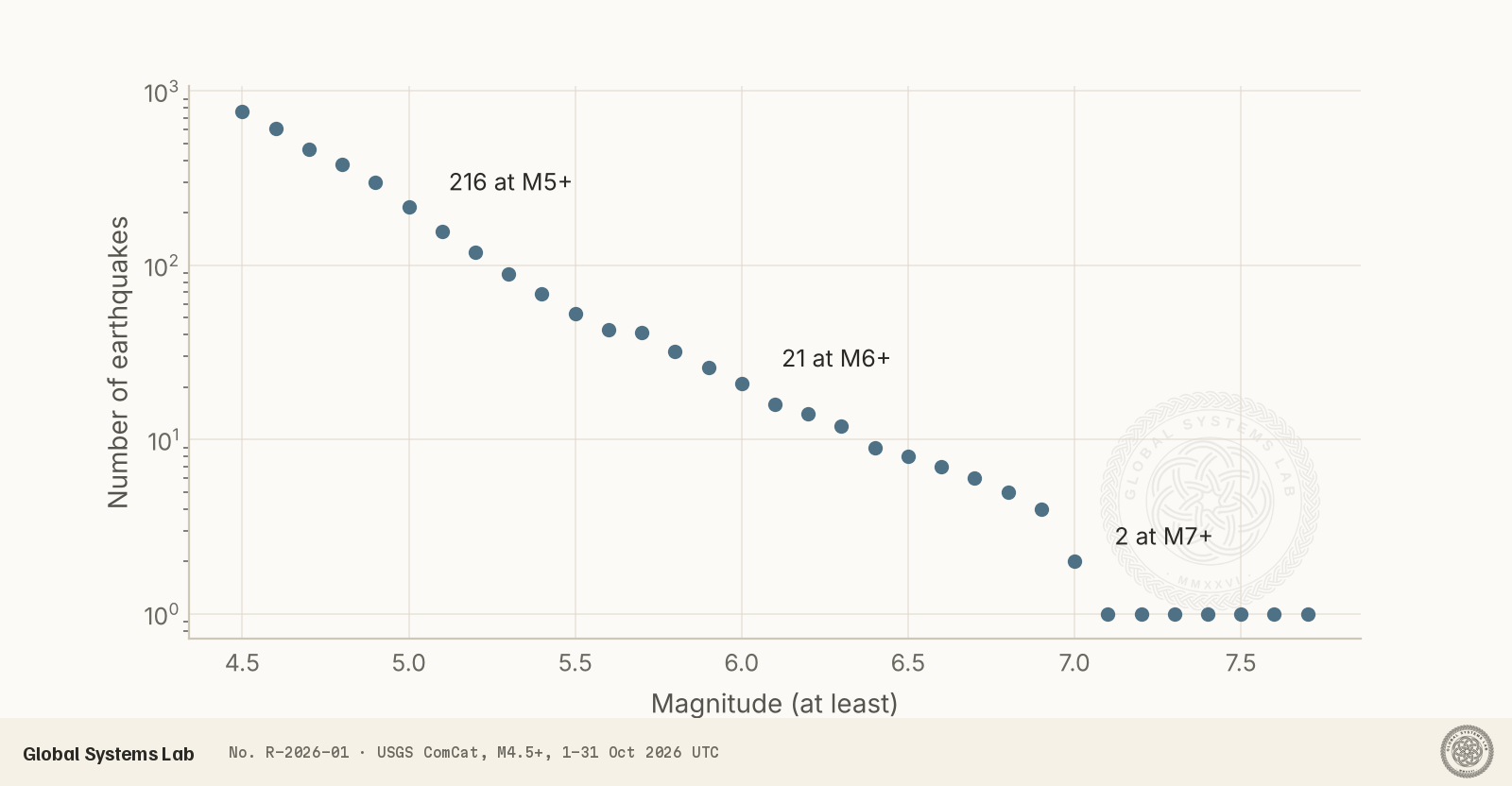
Large earthquakes are rare and small ones common in a remarkably regular way. In October, each step of one magnitude unit brought about twelve times fewer earthquakes: 766 of magnitude 4.5 or more, 216 of 5 or more, 21 of 6 or more and two of 7 or more. That ratio sits close to the long-term global average, which means the month was busy but not oddly shaped. It had more earthquakes of every size, not a surplus of one size.
Uncertainty and limitations
A month is a short window. Earthquake counts vary a lot from one month to the next, mostly because large earthquakes come with aftershocks: remove the Panama and Vanuatu sequences and October 2026 looks like an ordinary month. The comparison with earlier Octobers uses catalogue counts as they stand today; older years have been fully reviewed, while October 2026 is still preliminary, and its counts and magnitudes may shift slightly. Magnitudes near 4.5 carry uncertainties of a tenth or two, enough to move a handful of events across the threshold. Finally, felt reports depend on where people live and whether they report, so they measure human exposure as much as shaking.
Conclusions
October 2026 was a lively month for large earthquakes, about a quarter busier than a typical October and with twice the usual number of magnitude 6 events. Nearly all of the excess traces to two sequences: the magnitude 7.7 Panama earthquake and its fast-fading aftershocks, and a slow-burning swarm north-west of Vanuatu. Neither pattern is unusual for its setting, and a busy month does not mean the planet is becoming more active. For the weeks ahead, the Panama sequence should keep quieting, though occasional magnitude 5 aftershocks remain likely, while the Vanuatu swarm, which was still producing magnitude 5 events on the last day of the month, deserves watching. We will return to both in next month’s review.
References
- U.S. Geological Survey (2026). ANSS Comprehensive Earthquake Catalog (ComCat), event query for 2026-10-01 to 2026-10-31, magnitude 4.5 and above. Accessed 1 November 2026. https://earthquake.usgs.gov/fdsnws/event/1/
- U.S. Geological Survey (2026). Prompt Assessment of Global Earthquakes for Response (PAGER) alerts for the M7.7 Panama and M7.0 Xizang earthquakes. Accessed 1 November 2026. https://earthquake.usgs.gov/data/pager/
- Gutenberg, B. and Richter, C. F. (1944). Frequency of earthquakes in California. Bulletin of the Seismological Society of America, 34(4), 185–188.
- Utsu, T., Ogata, Y. and Matsu’ura, R. S. (1995). The centenary of the Omori formula for a decay law of aftershock activity. Journal of Physics of the Earth, 43(1), 1–33.
- Bird, P. (2003). An updated digital model of plate boundaries. Geochemistry, Geophysics, Geosystems, 4(3), 1027. https://doi.org/10.1029/2001GC000252
Data availability
The earthquake list behind every figure is available below as a CSV file (time, latitude, longitude, depth and magnitude for all 766 events), drawn from the USGS ComCat catalogue on 1 November 2026. Catalogue values can change slightly as the USGS reviews events, so later downloads may differ. You can explore the same month interactively in the Earthquake Explorer.
Cite this
Global Systems Lab (2026). October 2026: a busy month for the world's large earthquakes. Global Systems Lab Transmission R-2026-01. https://globalsystemslab.com/transmission/world-earthquakes-october-2026
BibTeX
@techreport{lab2026world,
  author = {Global Systems Lab},
  title = {October 2026: a busy month for the world's large earthquakes},
  institution = {Global Systems Lab},
  number = {R-2026-01},
  year = {2026},
  month = {nov},
  url = {https://globalsystemslab.com/transmission/world-earthquakes-october-2026}
}